How an audit runs with TellMeHow
Four steps, four roles. The consultant keeps the method and the judgment, the employee stays in control of what they say, and the AI takes on collection and consolidation.
The four steps of an audit
From the first setting to the published deliverable, in order.
-
1 The consultant
Set up the engagement
They pick their method, describe the audited company, create the populations (Accounting, Sales admin, Logistics…), and import the participants. The AI proposes an interview plan for each population, which they adjust.
- Topics inherited from the method, adjusted per population and per person.
- A checked welcome screen: launch is refused if a mandatory notice is missing.
- Preview: the consultant plays the interview in test mode, with no effect on the analysis.
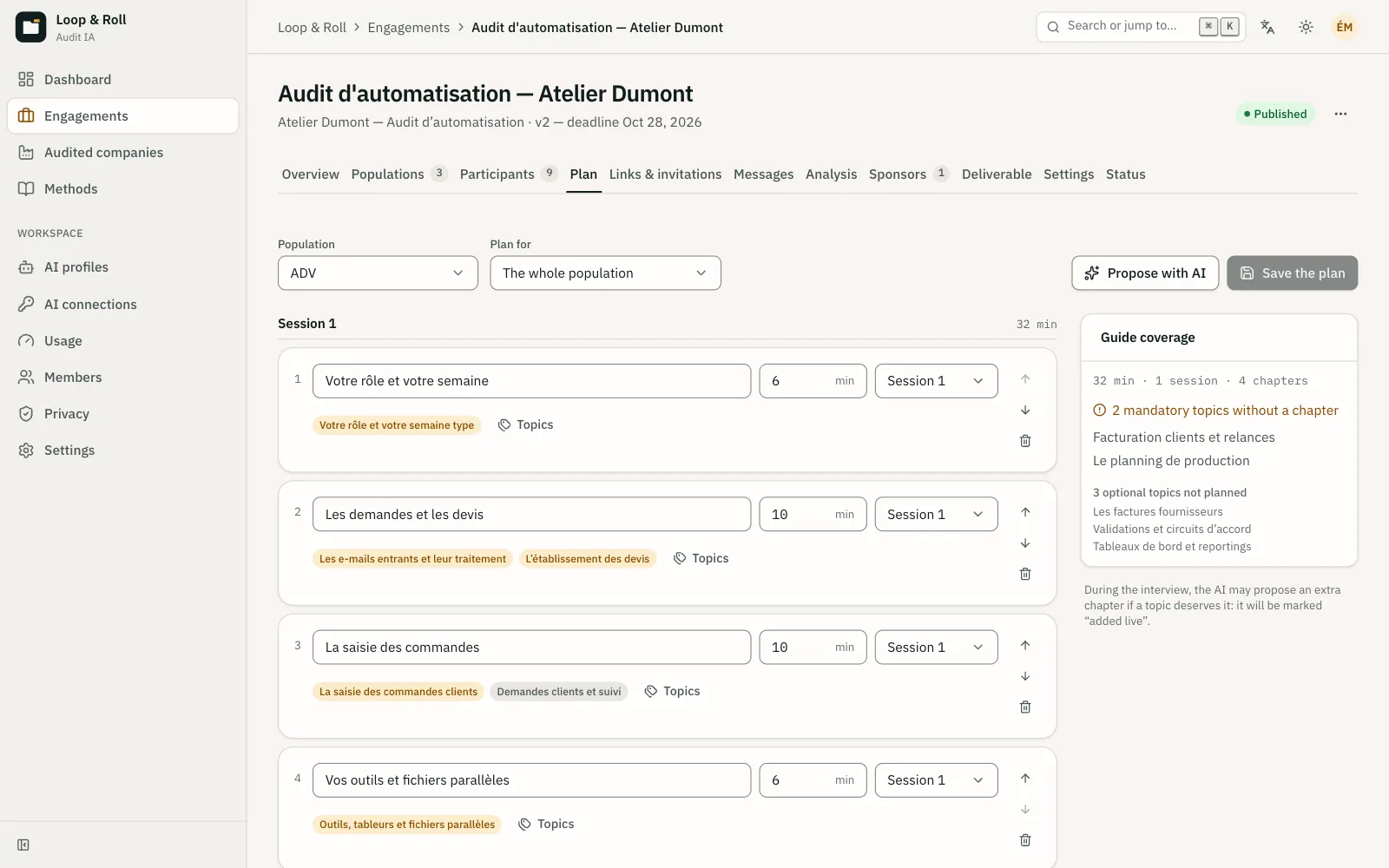
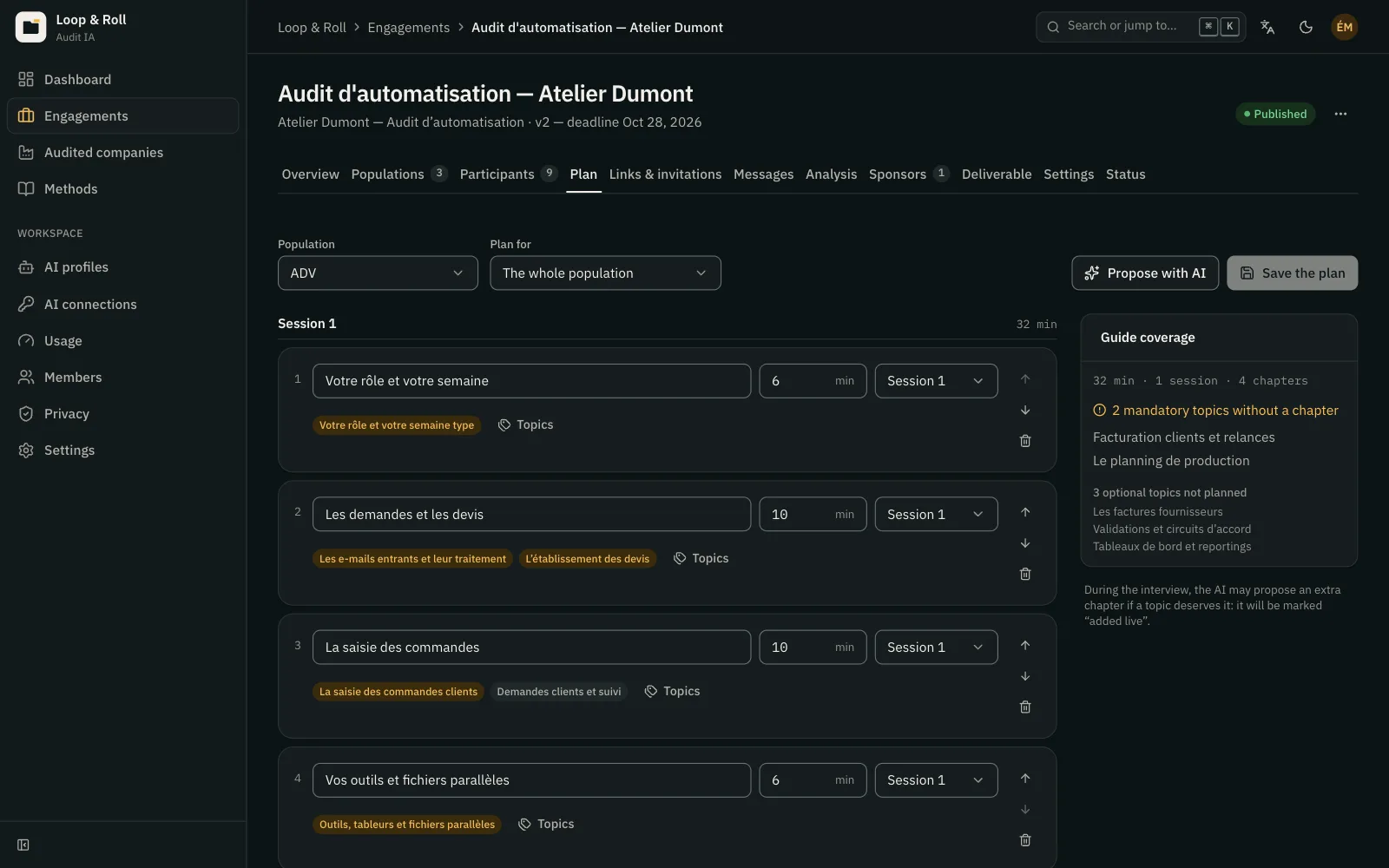
The interview plan for a population, chapter by chapter. Application screenshot, fictional demo engagement “Atelier Dumont”. -
2 The employee and the AI interviewer
Run the interviews
Each participant receives a link. They do their interview whenever they want, from their browser, in one or more sessions. The AI interviewer follows the guide, follows up when an answer is vague, and asks to see the screen.
- Guided technical check: microphone, sound, screen sharing, a macOS guide.
- Pause, resume with a thirty-second recap, stop for today.
- Pins and file uploads during the conversation.
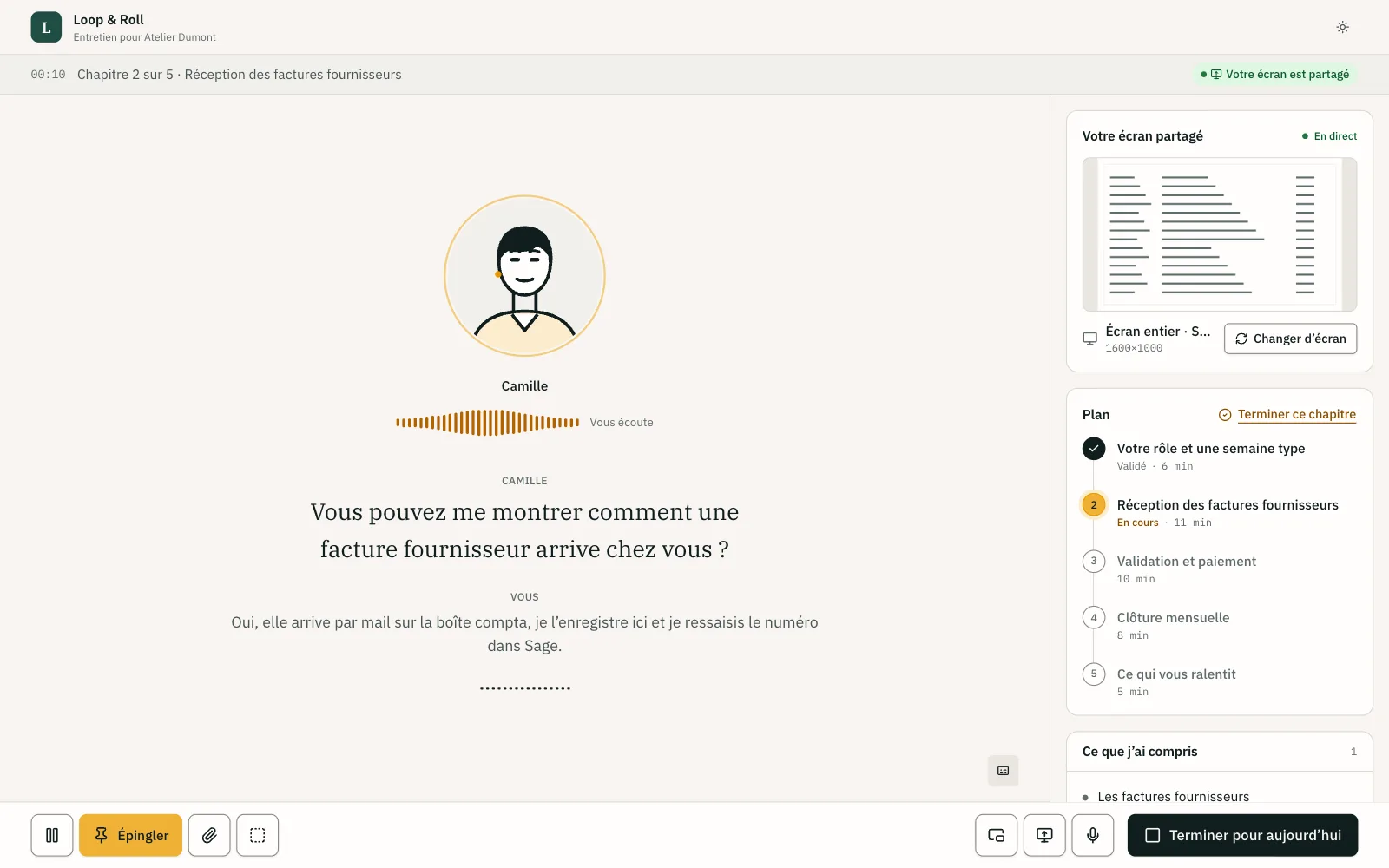
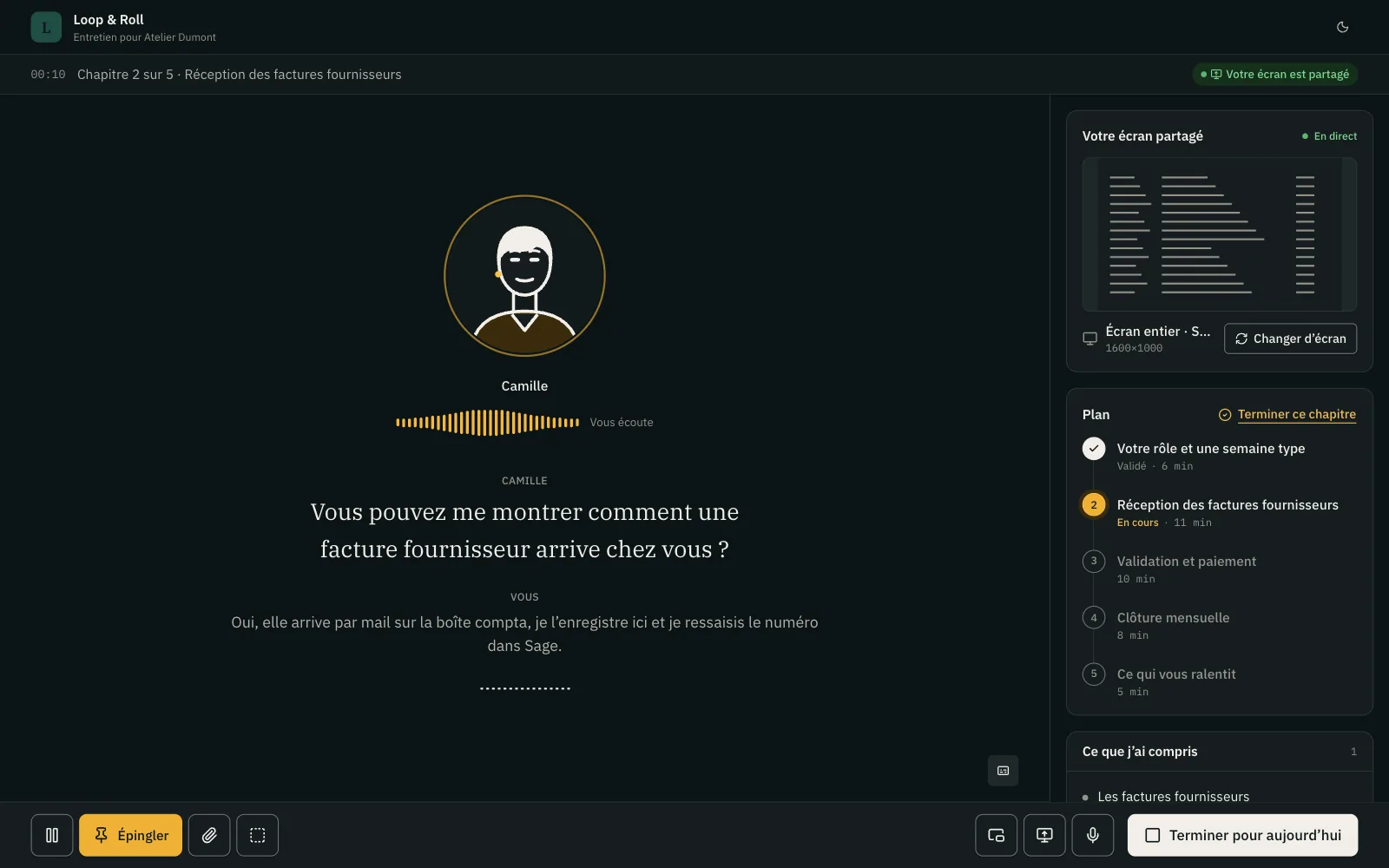
The interview from the employee’s side: a voice, a plan, what is kept, live. Application screenshot, fictional demo engagement “Atelier Dumont”. -
3 The employee
Validate what was kept
At the end of each chapter, they review what the AI understood: facts, figures, tools, pain points. They correct, clarify, remove, then validate. A chapter that is not validated is never used.
- Every point can be validated, corrected, or removed.
- A passage of the recording can be deleted.
- What is removed disappears from the analysis, the evidence, and the deliverable.
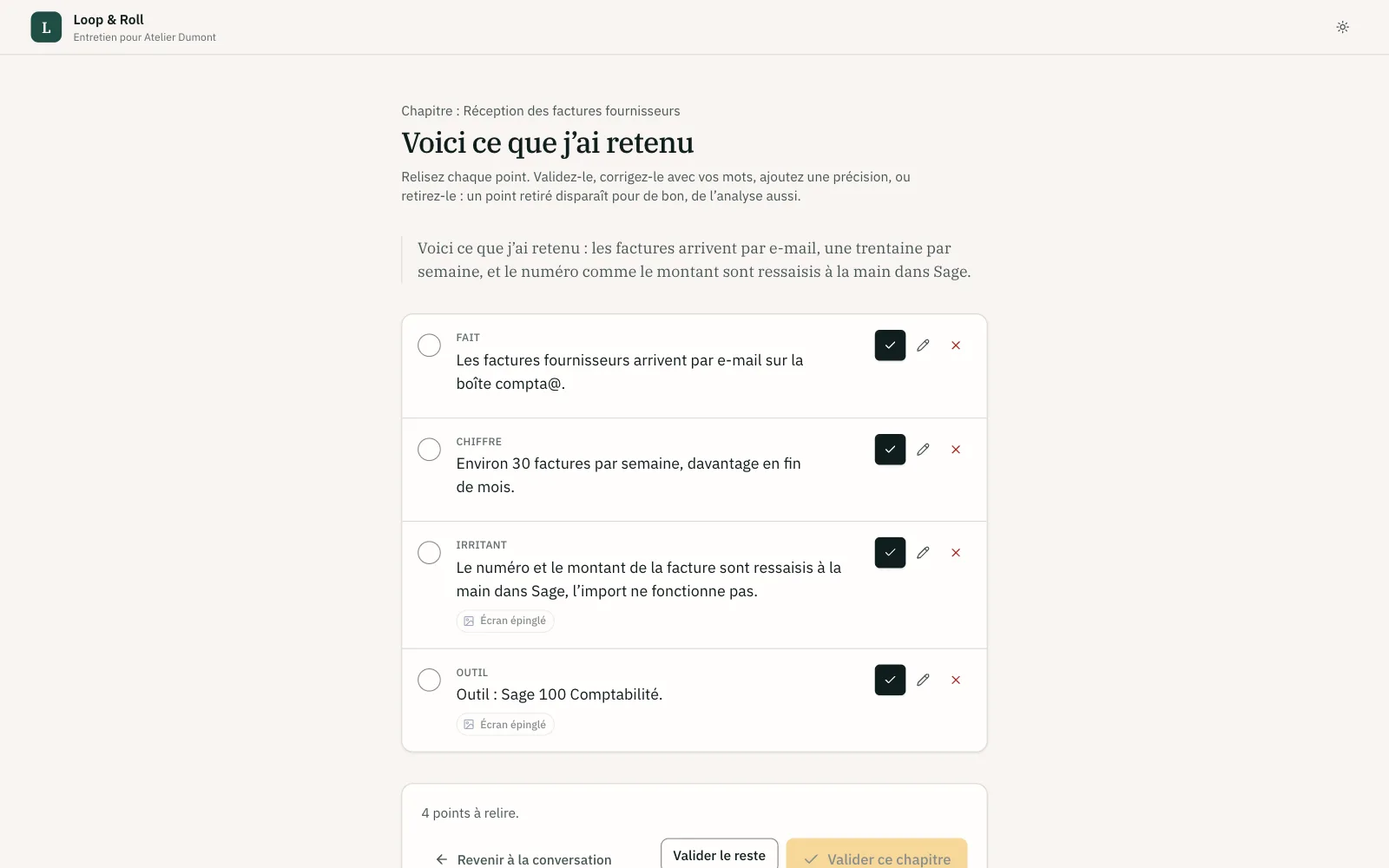
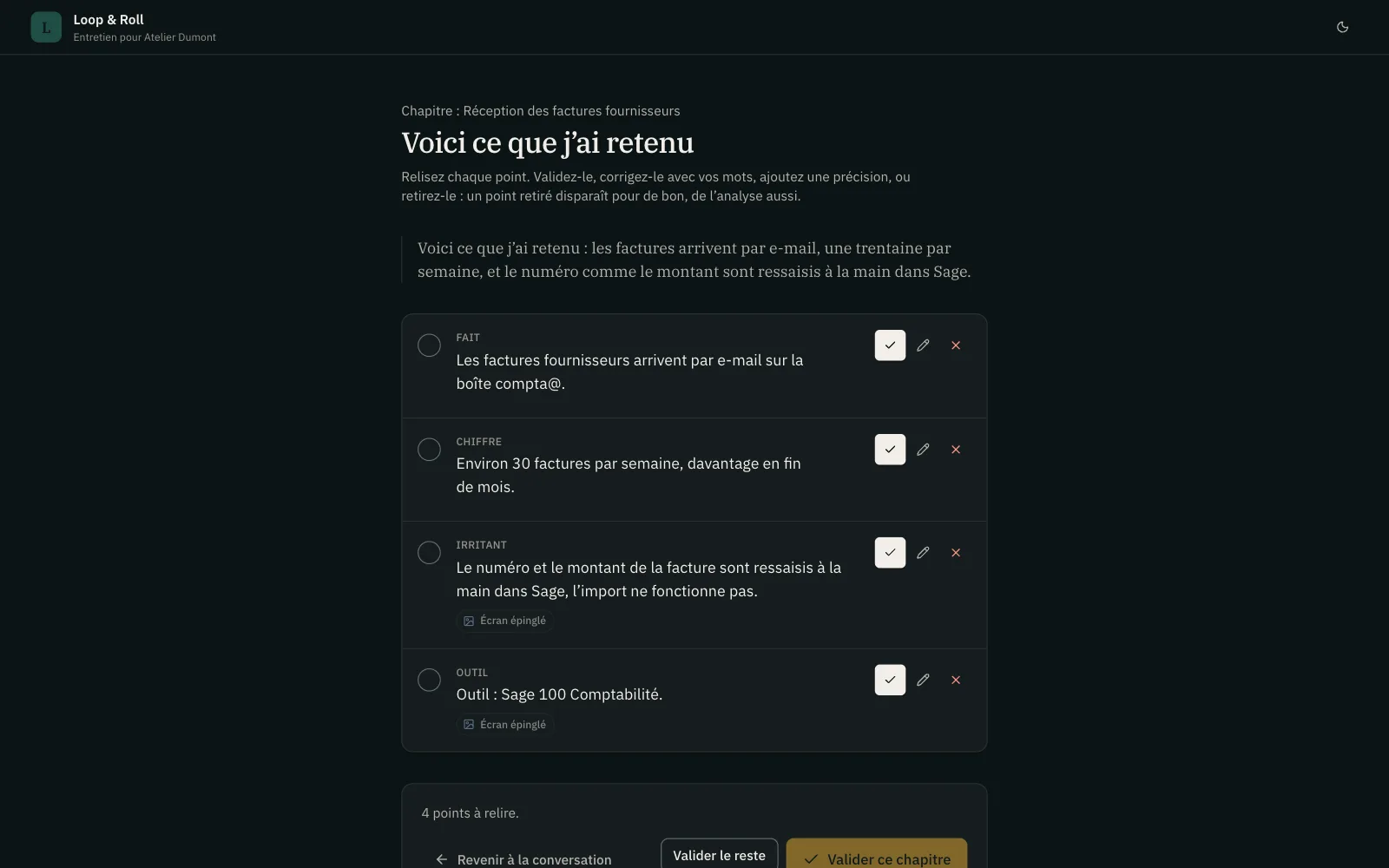
The chapter recap: the employee validates, corrects, or removes every point. Application screenshot, fictional demo engagement “Atelier Dumont”. -
4 The consultant
Analyze, follow up, publish
The analysis grows with every validated interview: processes, findings, contradictions, opportunities. The consultant corrects, triggers the proposed follow-ups, picks the evidence that can be published, and publishes a version of the deliverable for the sponsor.
- The consultant’s corrections are never overwritten by a new analysis.
- Targeted follow-ups: a few questions, a few minutes, to the right participant.
- Published versions: the sponsor sees what changed from one version to the next.
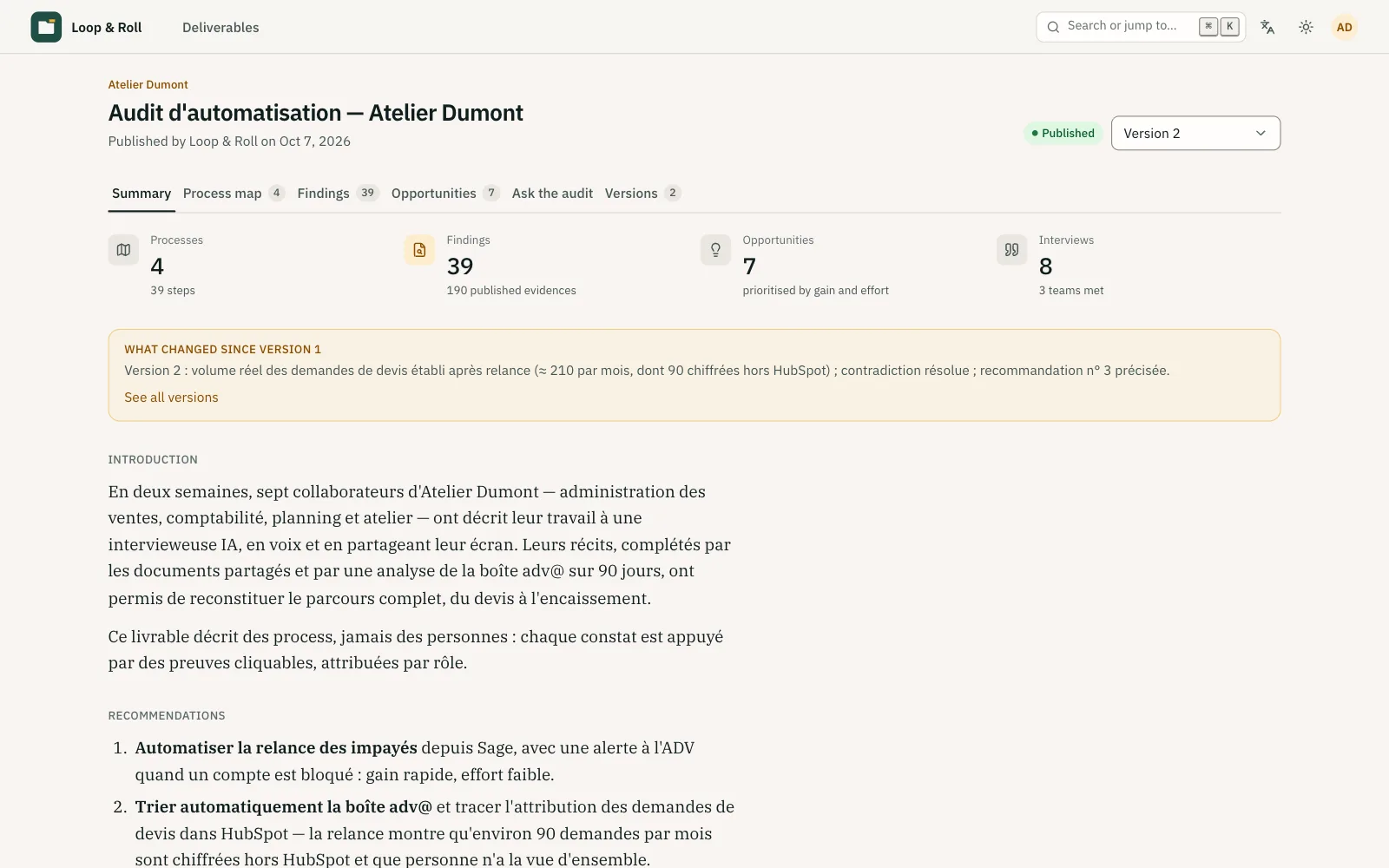
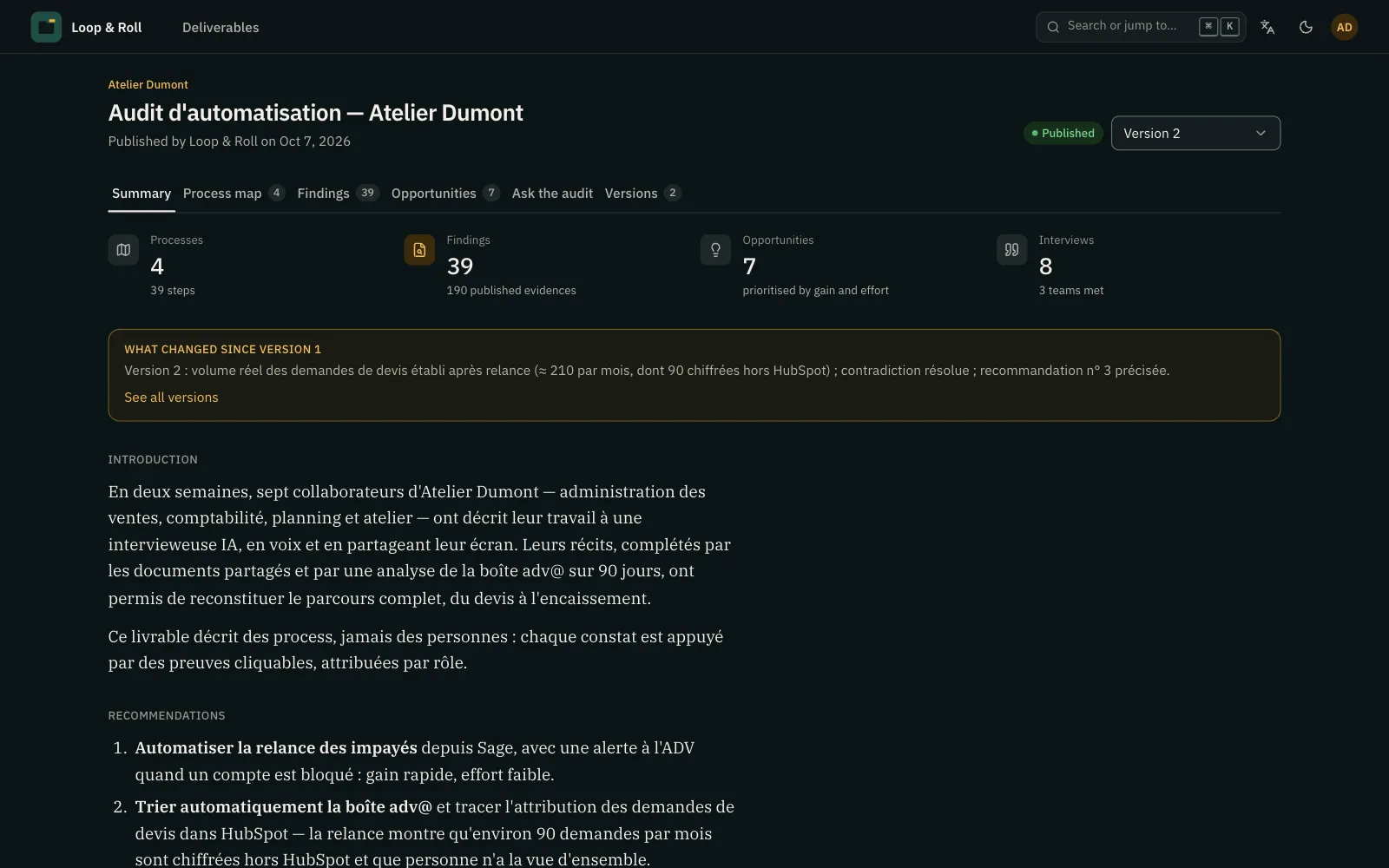
The published deliverable, as the sponsor reads it. Application screenshot, fictional demo engagement “Atelier Dumont”.
Who does what
-
The firm admin
Invites consultants, sets the brand and languages, chooses the AI providers and retention periods.
-
The consultant
Prepares and follows their engagements, reviews the analysis, decides on follow-ups, publishes the deliverable.
-
The audited employee
Does their interview through a personal link, without an account, and validates what is kept. They only see their own interview.
-
The sponsor
On the audited company’s side, follows aggregated progress, then reads the deliverable and questions the audit.
An interview session, step by step
What the employee experiences, from opening the link to validation.
Indicative times: an interview has no fixed length; it takes as long as the topics require.
-
0:00
Welcome
Who runs the audit and why, what is recorded, who sees what, for how long, their rights. They pick their language and accept.
-
0:02
Technical check
Microphone, speaker, full-screen sharing. On a Mac, a step-by-step guide if the browser does not have permission yet.
-
0:04
The plan
The interview chapters, an indicative duration for each, and where they stand.
-
0:05
The conversation
The AI interviewer asks, follows up, asks to see. The employee can interrupt at any moment; it stops speaking at once.
-
0:40
End of chapter
“Shall we continue or pick this up later?” They can stop there and come back through the same link.
-
0:42
The recap
They review what was kept, correct or remove points, then validate the chapter.
Frequently asked questions
How long does an interview last?
There is no fixed length. The interview is split into chapters, each with an indicative duration; the employee can do it in one sitting or several sessions, and the AI suggests a break after about an hour of continuous conversation.
How do participants receive their link?
Through an email sent from the tool, using a customizable, translated template, or through a copy of the links that the company sends itself. Automatic reminders can be scheduled for those who have not started.
What happens if the connection drops?
The session is marked as interrupted and what was said is kept. When the employee comes back through the same link, the AI interviewer recaps what was said and picks up where it left off.
Can the consultant test the interview before launching the engagement?
Yes. They play the interview as a participant, with a “test” banner, to check the tone, the plan, and the welcome screen. Test data never goes into the analysis.
When is the deliverable ready?
The analysis grows from the first validated interview. The consultant publishes when the process map holds up; they can publish a new version after follow-ups, and the sponsor sees what changed.
See a complete audit in thirty minutes.
A voice interview with screen sharing, the process map it produces, the deliverable the sponsor reads: on a demo engagement, with your questions.