Cross-check every interview, and see where accounts diverge
The analysis turns each validated interview into typed findings linked to their evidence. When two sources contradict each other, it puts them side by side and proposes the follow-up that will settle it.
- Every finding rests on at least one clickable piece of evidence
- Targeted follow-ups of 2 to 5 questions, approved by the consultant
- Consultant edits are never overwritten by the analysis
The starting point
Consolidation happens in someone’s head
After fifteen interviews, the consultant cross-checks viewpoints in a spreadsheet. Noticing that accounting and sales describe different discount approvals, or estimating a volume from three rough answers, depends on memory and notes. Discrepancies found late mean calling people back.
Typed findings, each with its evidence
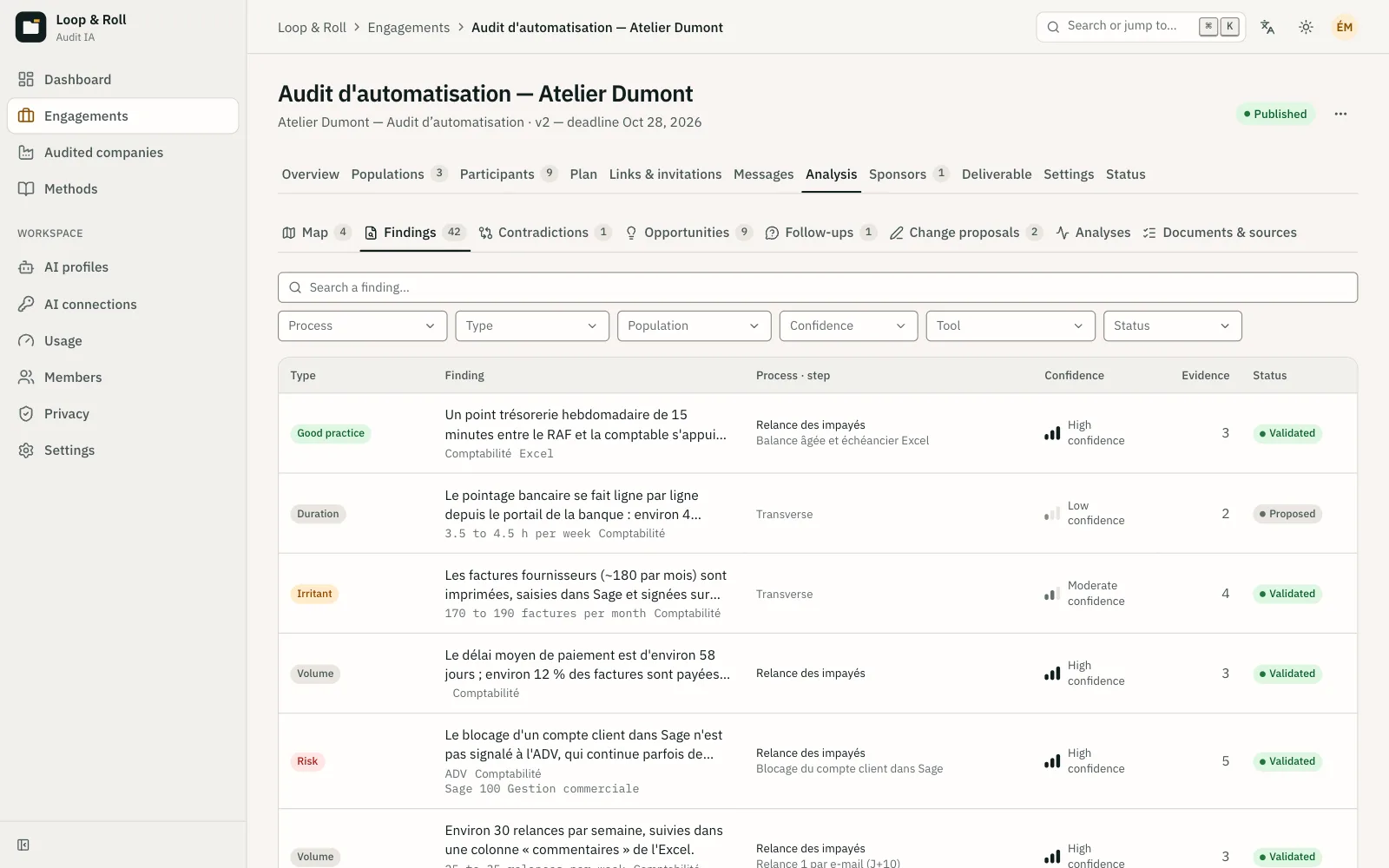
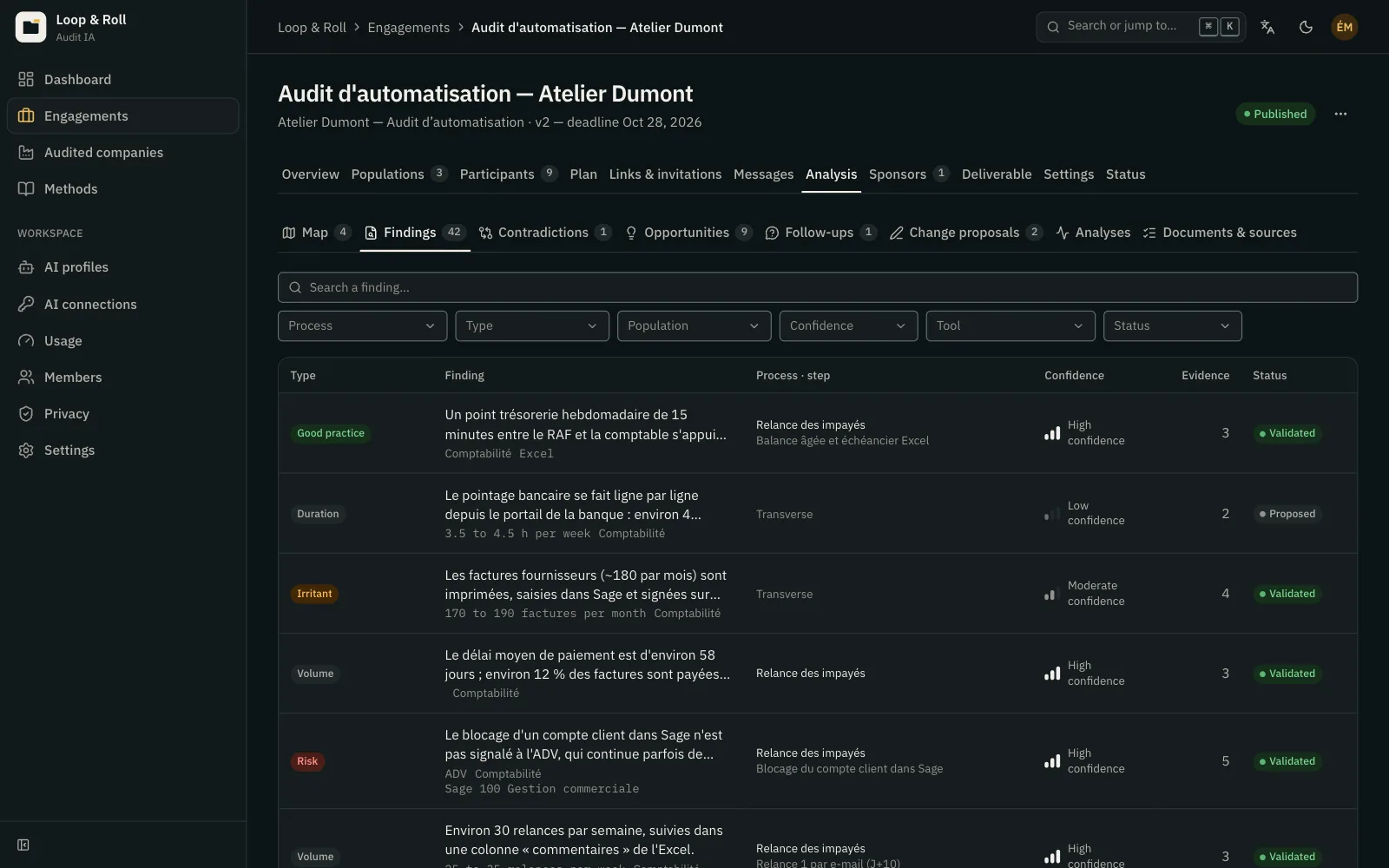
Each validated chapter enriches the analysis without recomputing everything. It extracts typed findings and matches them against existing ones: two phrasings of the same fact merge and pool their evidence. A finding without evidence doesn’t exist.
- Types: pain point, re-keying, volume, duration, business rule, tool, key-person dependency, risk, and good practice.
- A key-person dependency is phrased by role (“only the person in charge of month-end close knows…”), never by name.
- Confidence depends on how many sources agree: a fact both stated and shown on screen outweighs a single statement.
- Every piece of evidence points to a timestamped excerpt, a screen capture, a pin, or a page in a file.
Contradictions, side by side
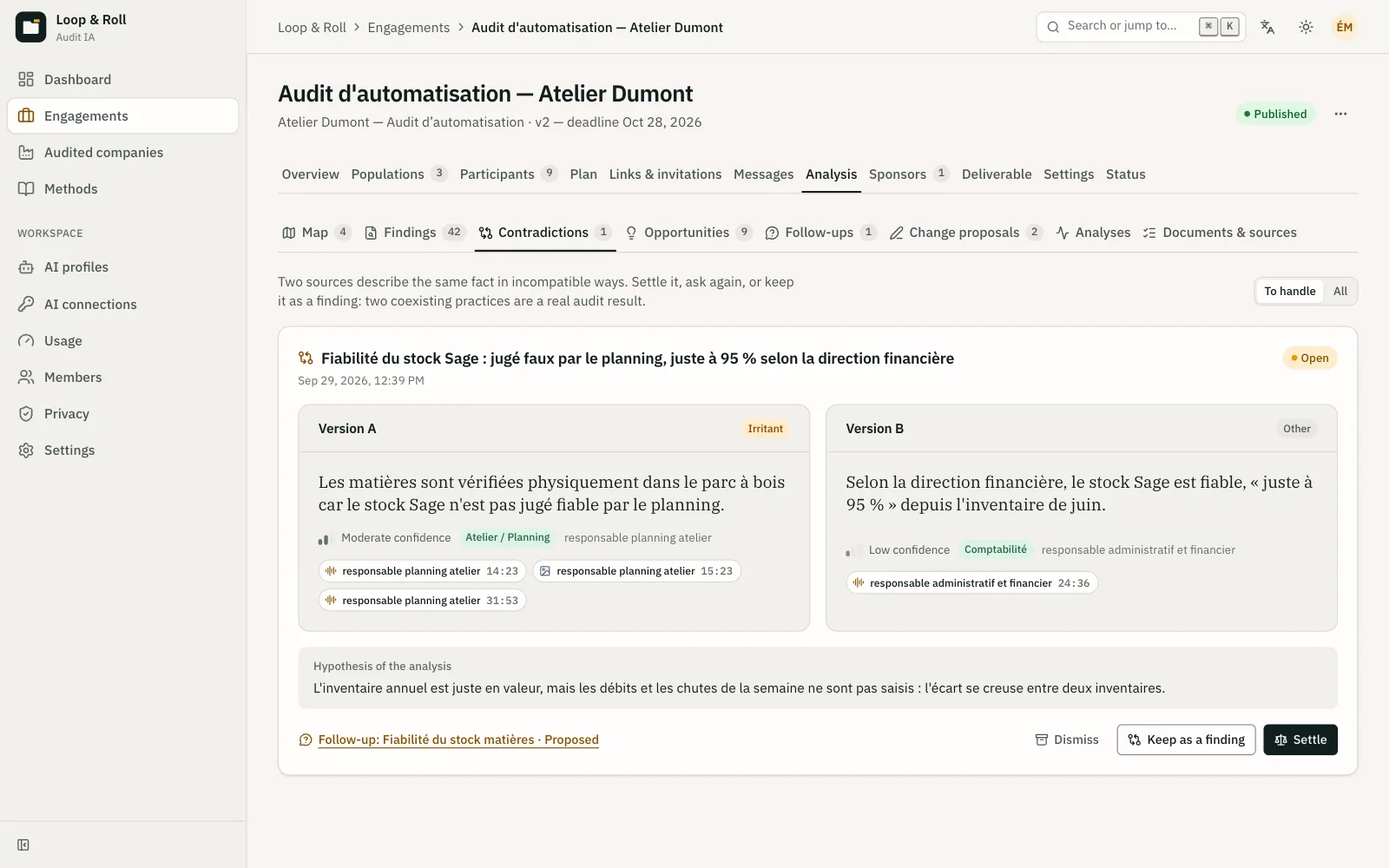
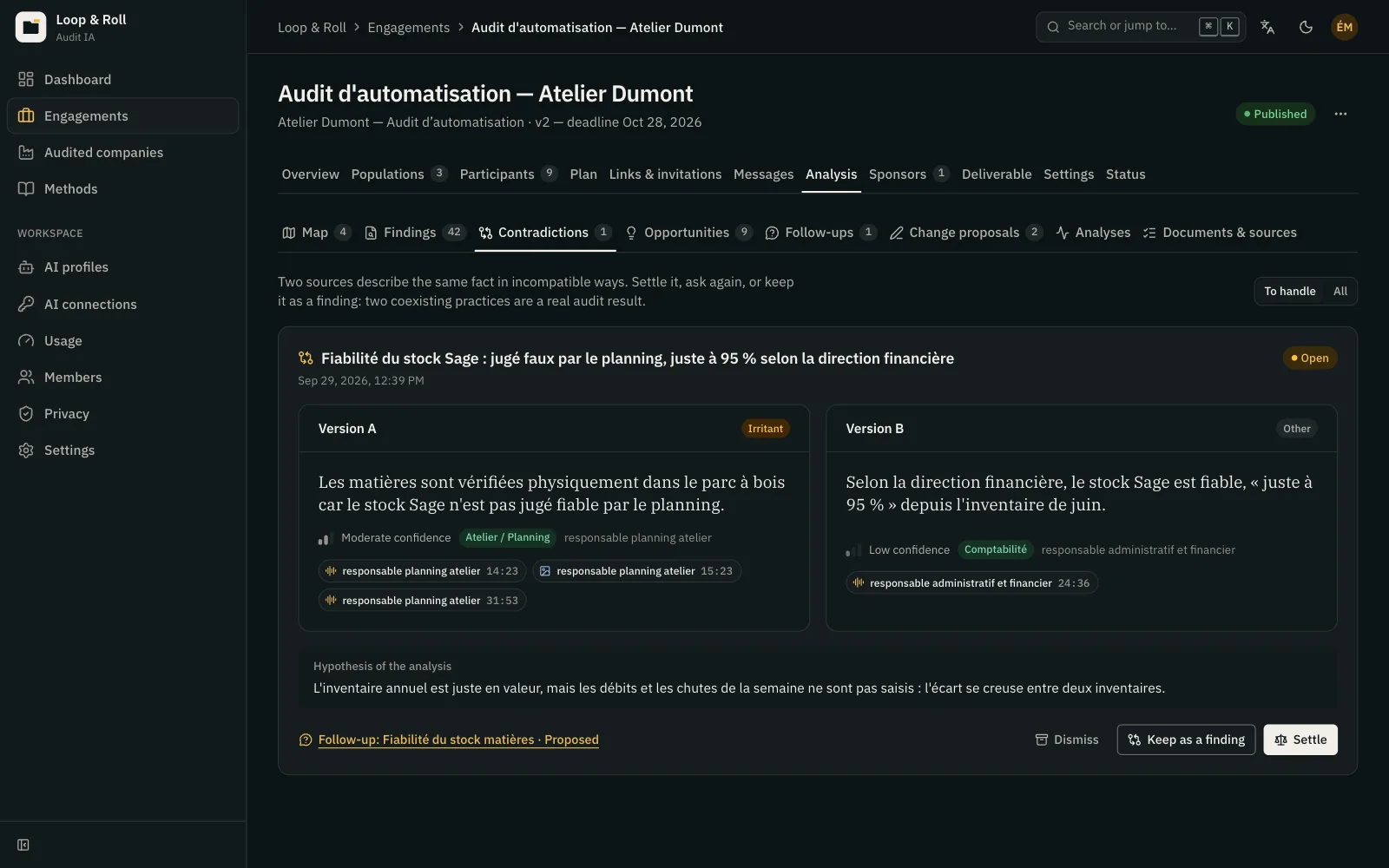
When two sources describe the same fact in incompatible ways, the analysis creates a contradiction: both versions with their evidence, a hypothesis, and a proposed follow-up. For example, sales administration describes approval for every order over €5,000, while sales management says only key accounts need it. The consultant settles it, sends a follow-up, or keeps the contradiction as a finding.
- The hypothesis is framed as a question to check: “do two practices coexist across branches?”
- “Two practices coexist” is an audit result in its own right, not an error to fix.
- An open contradiction caps the confidence of both findings involved.
Targeted follow-ups instead of a second interview
The analysis spots what keeps the map from holding together: a contradiction, a step whose input nobody described, a figure that is too uncertain, a required topic only skimmed. It proposes a short follow-up for the participants concerned. The consultant adjusts the questions and approves; the participant gets a link to a new chapter of their interview.
- A follow-up has 2 to 5 questions, with an estimated length of 5 to 10 minutes.
- It has its own recap, which the participant validates like any other chapter.
- Once validated, it updates the findings and the original contradiction.
External sources and protected edits
An engagement can import data that doesn’t come from an interview, in a public, documented exchange format: metrics, pre-written findings, known processes. The analysis treats them as quantitative evidence that confirms, qualifies, or contradicts the interviews. An imported mailbox analysis might show 210 quote requests a month where interviews estimated 50.
- Any tool can produce an external source, and firms can import their own analyses.
- The consultant renames, adjusts, approves, or rejects, and those edits are locked.
- A new analysis proposes changes to accept rather than rewriting; a rejected finding isn’t proposed again.
In practice
- Inputs
- Validated recaps, the transcript excerpts and screen images they cite, pins, files, and the engagement’s external sources; never an unvalidated chapter or a test session.
- Cadence
- Incremental analysis on each validated chapter, extracted file, or imported source; full analysis on the consultant’s request.
- Confidence
- High, medium, or low, based on the number of sources, their agreement, their populations, and on-screen observation.
- Contradiction
- Two versions with their evidence, a hypothesis, and a proposed follow-up; the consultant settles it, follows up, or keeps it as a finding.
- Follow-up
- A chapter of 2 to 5 questions, estimated at 5 to 10 minutes, proposed by the analysis and approved by the consultant before sending.
- Exchange format
- Public JSON with a versioned schema, for importing metrics, findings, and processes produced by other tools.
- Safeguards
- Participant names are never passed to the analysis; any statement that assesses a person or mentions an emotion is rejected.
Frequently asked questions
Where does each finding come from?
Every finding is linked to at least one piece of evidence: a timestamped transcript excerpt, a screen description, a pin, a page in a file, or external source data. A finding that loses all its evidence, for example after a participant removes a point, is deleted.
What happens when two employees contradict each other?
The analysis creates a contradiction showing both versions side by side with their evidence, a hypothesis, and a proposed follow-up. The consultant settles it, sends the follow-up, or keeps the contradiction as a finding, since two coexisting practices are an audit result.
Can the analysis overwrite the consultant’s corrections?
No. Every consultant edit is locked. A later analysis can propose a change, which the consultant accepts or rejects, and a rejected finding isn’t proposed again.
Can we bring in data from other tools?
Yes, by importing it in a public, documented exchange format: metrics, findings, or processes. This data confirms, qualifies, or contradicts the interviews. There are no direct connectors to the client’s systems.
Does the analysis compare employees with each other?
No. It describes processes, phrased by role, with no ratings, rankings, or individual comparisons. Participant names are never passed to it, and any statement that assesses a person is rejected.
Related features
- Process map Processes rebuilt step by step, with actors, tools, volumes, and pain points, each one sourced.
- Deliverable and chat A published space for the sponsor, where every finding links to its evidence and the audit answers questions.
- Validated recap Employees review, correct, and approve what the AI took away before it is used in the analysis.
Use cases where it matters
- Digital transformation The baseline before the program: the tools people actually use, not just the ones on the IT roadmap.
- Automation agencies Spot repetitive tasks, estimate their volumes with sources, and back every proposal with facts.
- Order to cash Audit the sales chain from quote request to overdue invoice follow-up, one team at a time.
- Procure to pay Audit purchasing from requisition to payment, and spot the approvals that are missing.
See a complete audit in thirty minutes.
A voice interview with screen sharing, the process map it produces, the deliverable the sponsor reads: on a demo engagement, with your questions.