Your audit method, applied to every interview
The interview guide inherits across four levels, from the firm’s method down to the participant. The AI interviewer follows your topics, tone, and off-limits subjects, and won’t wrap up until the essentials are covered.
- Four levels: method, engagement, population, participant
- Where each guide element comes from is always visible
- No wrap-up while a required topic is neither covered nor skipped
The starting point
A generic AI asks generic questions
You don’t audit accounts payable the way you audit field service, or a manufacturing SME the way you audit a branch network. An unstructured conversation skims topics, forgets volumes, and drifts into things the engagement doesn’t need. The firm’s method is exactly what a generic tool lacks.
Four levels that inherit
The method holds the firm’s reusable know-how. The engagement adds the client company’s context: business, in-house vocabulary, acronyms, and known tools. The population adjusts the topics for a team, such as sales administration or accounting, and each participant gets their own specifics.
- Each level can add, change, or remove anything from the level above.
- The interface shows where each element comes from (method, engagement, population) and what was overridden.
- A consultant’s note on a participant, such as “handles supplier reminders alone,” steers the interview.
- The AI can suggest topics for a population from the method and context; nothing is kept without your approval.
The topic, the building block of the guide
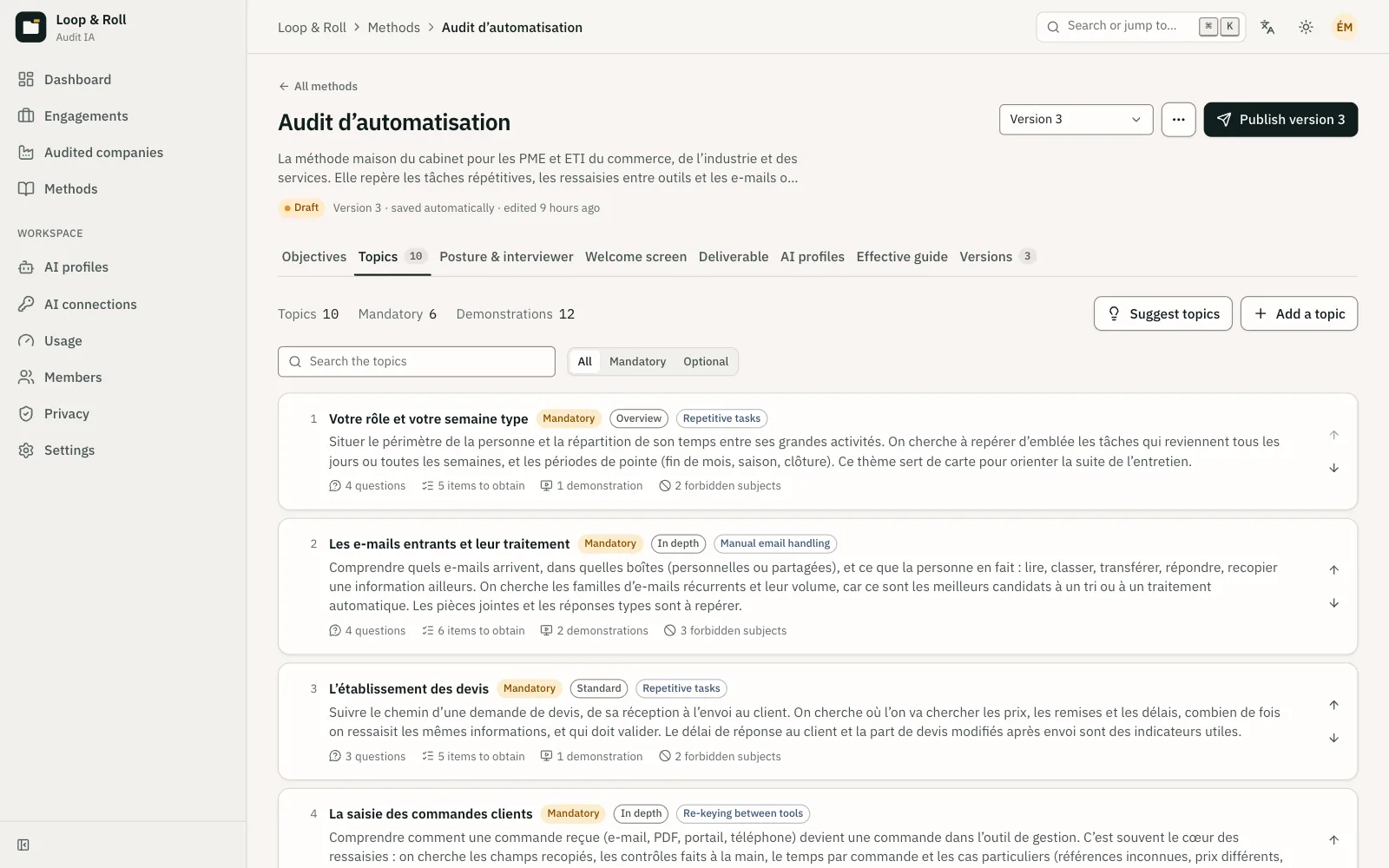
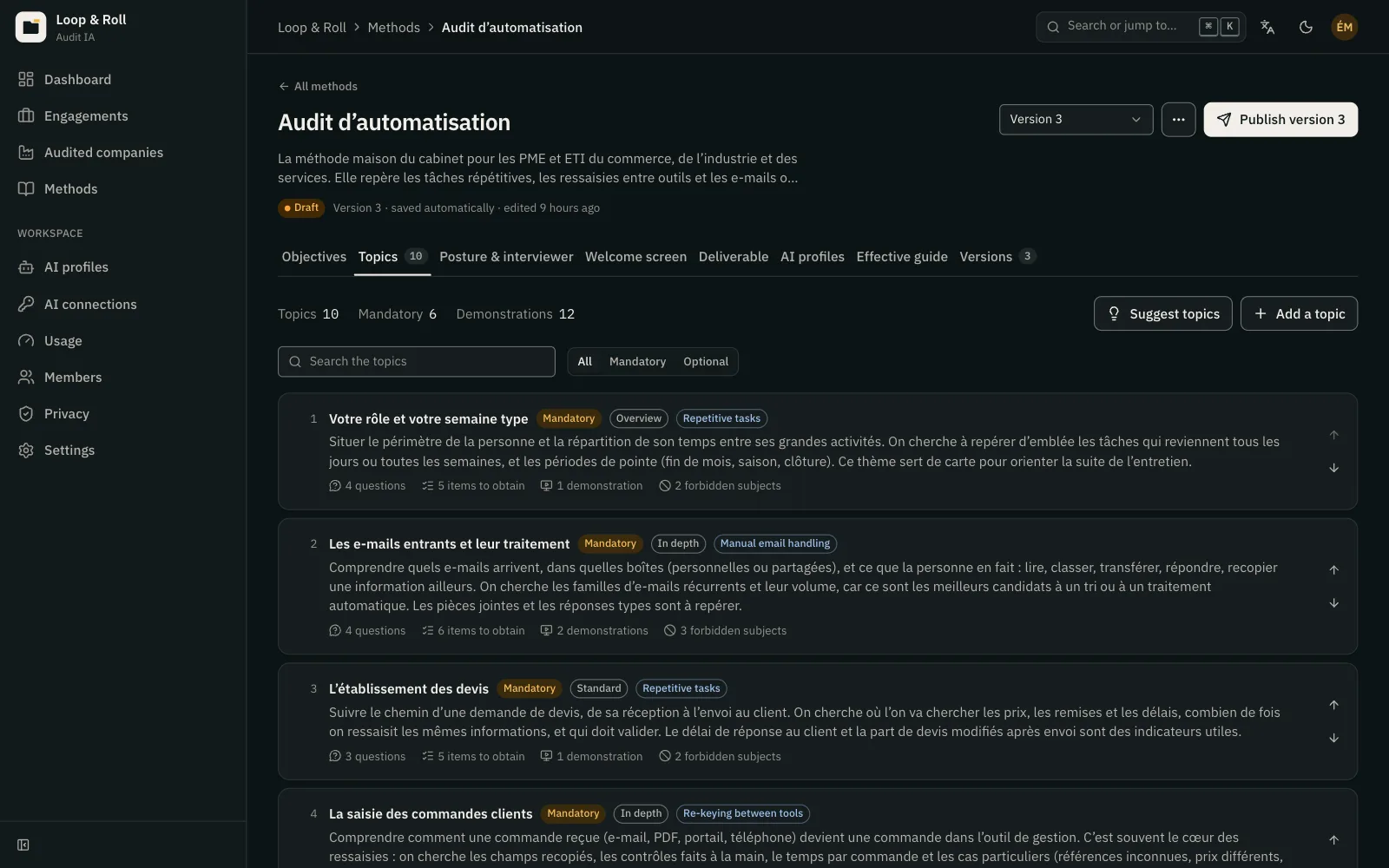
A topic describes what you want to understand, written for both the AI and the consultant. It is required or optional, with an expected depth (overview, standard, or in-depth) that sets how much the AI probes. Its opening questions are rephrased, never read out.
- Information targets (“monthly volume,” “tool used,” “who approves”) determine whether the topic is covered.
- Expected demonstrations, such as “show me how you enter an order,” are requested at the right moment.
- Off-limits or sensitive subjects, such as pay or workplace conflicts, are never raised.
- Each topic specifies the deliverable section where its findings appear.
Coverage tracked by the product
During the interview, the AI interviewer records the information obtained, topic by topic. A required topic counts as covered only when its information targets are met, or when the participant clearly says they don’t know, which is itself useful information. It won’t wrap up while a required topic is neither covered nor explicitly skipped.
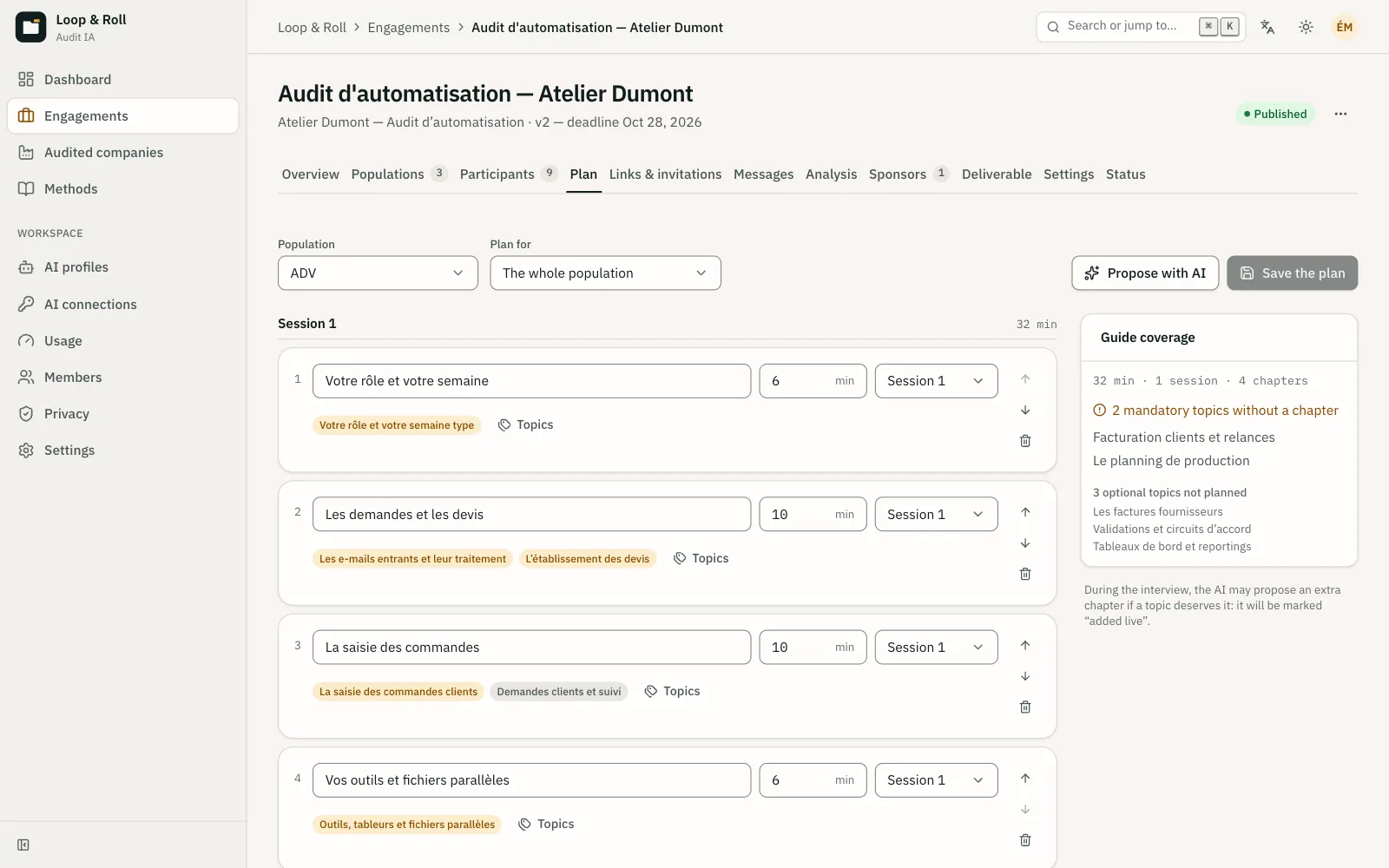
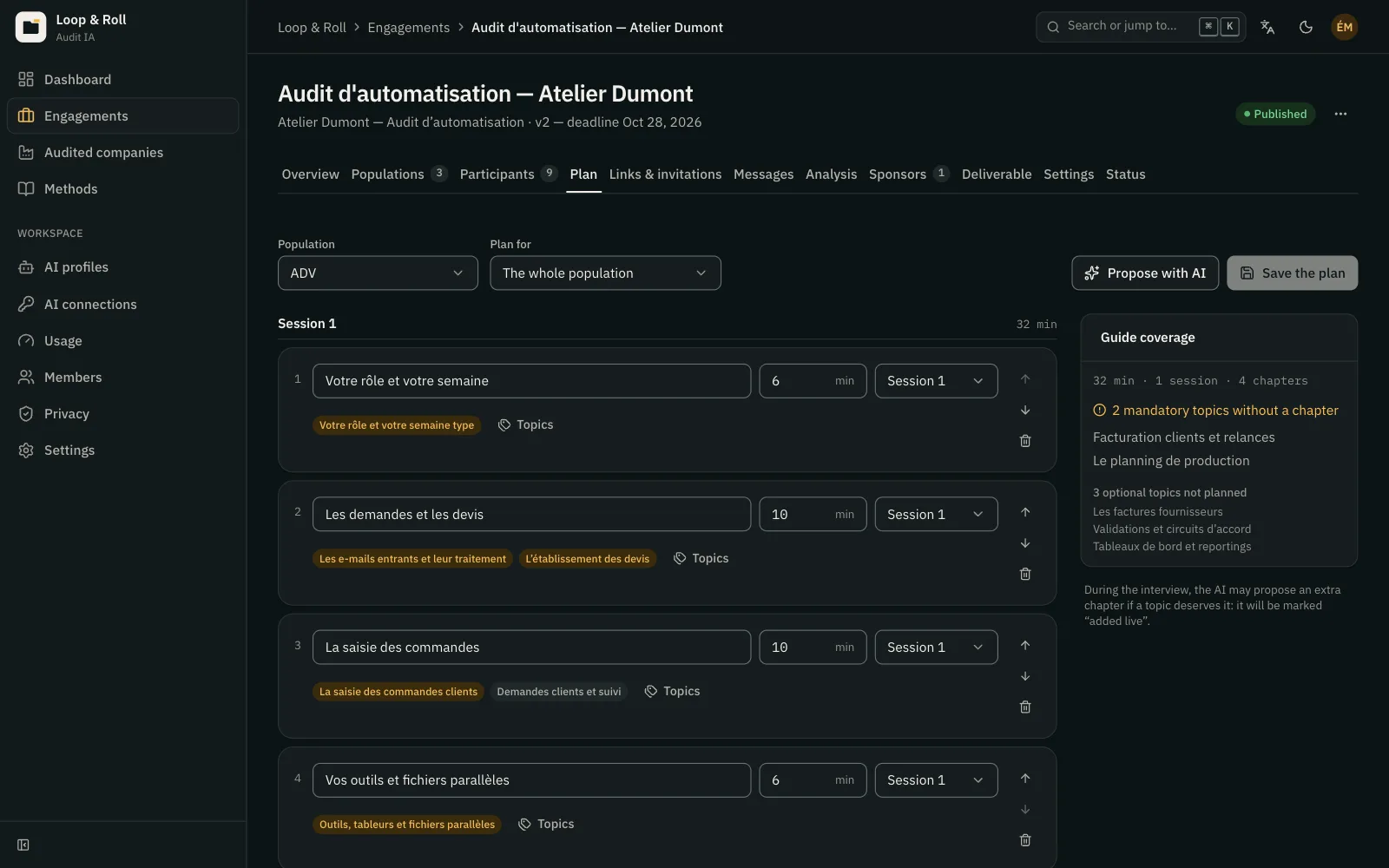
- The plan is set by the consultant, proposed by the AI and then approved, or adapted during the interview.
- A chapter added mid-interview, for instance on a second inventory system, is flagged to the consultant.
- Posture is set in the method: register, formality, how hard to probe, first name, voice, and free-form instructions.
What interviews share with each other
An engagement setting decides whether the AI interviewer can raise what others have already said. By default, sharing is anonymized: “others say invoices arrive already approved; is that the case for you?” This surfaces discrepancies during the interview rather than afterward.
- Off: each interview stands alone.
- Anonymized, the default: the AI raises findings without ever saying who stated them.
- By role: it can cite a team (“sales administration says…”), never a person’s name.
- Only other participants’ validated recaps are shared, never a removed passage.
In practice
- Method
- Topic library, generic objectives, posture, welcome screen, deliverable structure, and default AI profiles; versioned.
- Versions
- An engagement locks in the method version used at launch; editing the method doesn’t change engagements in progress.
- Welcome screen
- Translated text with variables; pre-written mandatory blocks (AI, recording, recipients, retention, rights) can be edited but not deleted.
- Launch check
- The product won’t launch an engagement whose welcome screen is missing a mandatory block.
- Plan
- Chapters set by the consultant, proposed by the AI, or added during the interview; sessions can be scheduled.
- Template methods
- Automation audit, process mapping, department audit, and systems audit: copyable and editable, in English and French.
Frequently asked questions
Can we use our own audit method?
Yes. The firm’s method is the first level of the guide: topics, objectives, the AI interviewer’s posture, the welcome screen, and the deliverable structure. You can start from scratch or copy a template method and adapt it.
Does the AI read the questions word for word?
No. Opening questions are a starting point: the AI interviewer rephrases them, probes according to the expected depth, and checks the information targets. It never raises subjects marked as off-limits.
How do you make sure an interview doesn’t miss something important?
Each required topic lists its information targets, and the product tracks their coverage during the interview. The AI interviewer won’t wrap up while a required topic is neither covered nor explicitly skipped by the participant.
Does editing the method affect engagements in progress?
No. The method is versioned, and each engagement keeps the version used at launch. New engagements use the latest version.
Does the AI interviewer reveal what other participants said?
Only if the engagement allows it, and never by name. By default, it raises established findings without saying who stated them; in by-role mode, it can cite a team. It relies only on validated recaps.
Related features
- Voice interviews Each employee talks to the AI interviewer when it suits them, in their browser, across several sittings.
- Your brand Your clients see your firm: subdomain, logo, colors, AI interviewer, and deliverable in your brand.
- Cross-analysis Every interview cross-checked into sourced findings, with contradictions and follow-ups to resolve them.
Use cases where it matters
- Organizational consulting An organizational diagnosis informed by every employee, with a process map that shows its sources.
- ERP / CRM integrators Requirements gathering grounded in how current systems are really used, with BPMN export.
- Field services Audit field operations with technicians who are rarely at a desk, straight from their phone.
See a complete audit in thirty minutes.
A voice interview with screen sharing, the process map it produces, the deliverable the sponsor reads: on a demo engagement, with your questions.