For consulting firms in organization, transformation, quality, IT, and automation.
Your audit interviews, run by voice by an AI that sees the screen.
Each employee does their interview whenever they want, showing how they work. TellMeHow then cross-checks every interview into a process map where each finding links back to its evidence, delivered by your firm.
Interviewer
Interview · Sales admin assistant · chapter 2
-
14:32
Interviewer
Could you show me how you enter an order?
-
14:41
Sales admin assistant
I start from the order form in the CRM, and I copy the customer number into the ERP.
-
14:58
Interviewer
I can see both windows side by side: do you type that number in by hand every time?
The customer number is copied by hand from the CRM into the ERP, for every order.
Order entry
Sales admin · ERP · 30 to 50 / day
- levels
-
4 levels
of interview guide: method, engagement, population, participant.
- AI uses
-
6 AI uses
set separately: voice, transcription, vision, analysis, chat, search.
- days
-
90 days
of raw recording retention by default, adjustable.
- installs
-
0 installs
for the employee: a personal link and a browser.
An audit in four steps
The consultant keeps the method and the judgment. The AI takes on collection and consolidation, the parts that cost the most and scale the least.
-
1
You set up the audit
Your method, the company context, the topics for each department, the people to interview. The AI can propose the interview plan; you approve it.
-
2
Everyone does their interview
A personal link, no account, nothing to install. The AI runs the interview by voice and asks to see the screen at the right moment, in one sitting or several.
-
3
The employee validates
At the end of each chapter, they review what was kept, correct it, remove points, then validate. Only what they validate feeds the analysis.
-
4
You review and deliver
The analysis cross-checks every interview: processes, findings, contradictions, opportunities. You adjust, follow up where needed, then publish the deliverable.
“Show me”, across the whole company
In an interview, people describe the process as it should be. The copy-paste between two tabs, the “temporary” spreadsheet from 2019, the re-keying into the ERP only show up when you watch the work.
- The AI asks to see when a demonstration is expected or when the employee describes a manual step.
- It says what it sees before drawing a conclusion, so the employee can correct it.
- The employee pins what matters: a sharp capture, a marker in the recording, a comment.
- Sensitive data on screen is redacted before anything is sent to the vision model.
CRM · Order form
Customer no.
104 772
Order
2026-0418
Amount
4 312,00
ERP · Order entry
Customer no.
104 772
Order
2026-0418
Amount
4 312,00
IBAN Redacted before sending
Interviewer
I can see two windows side by side. Does the customer number go from one to the other by hand?
Cross-analysis: where the value is
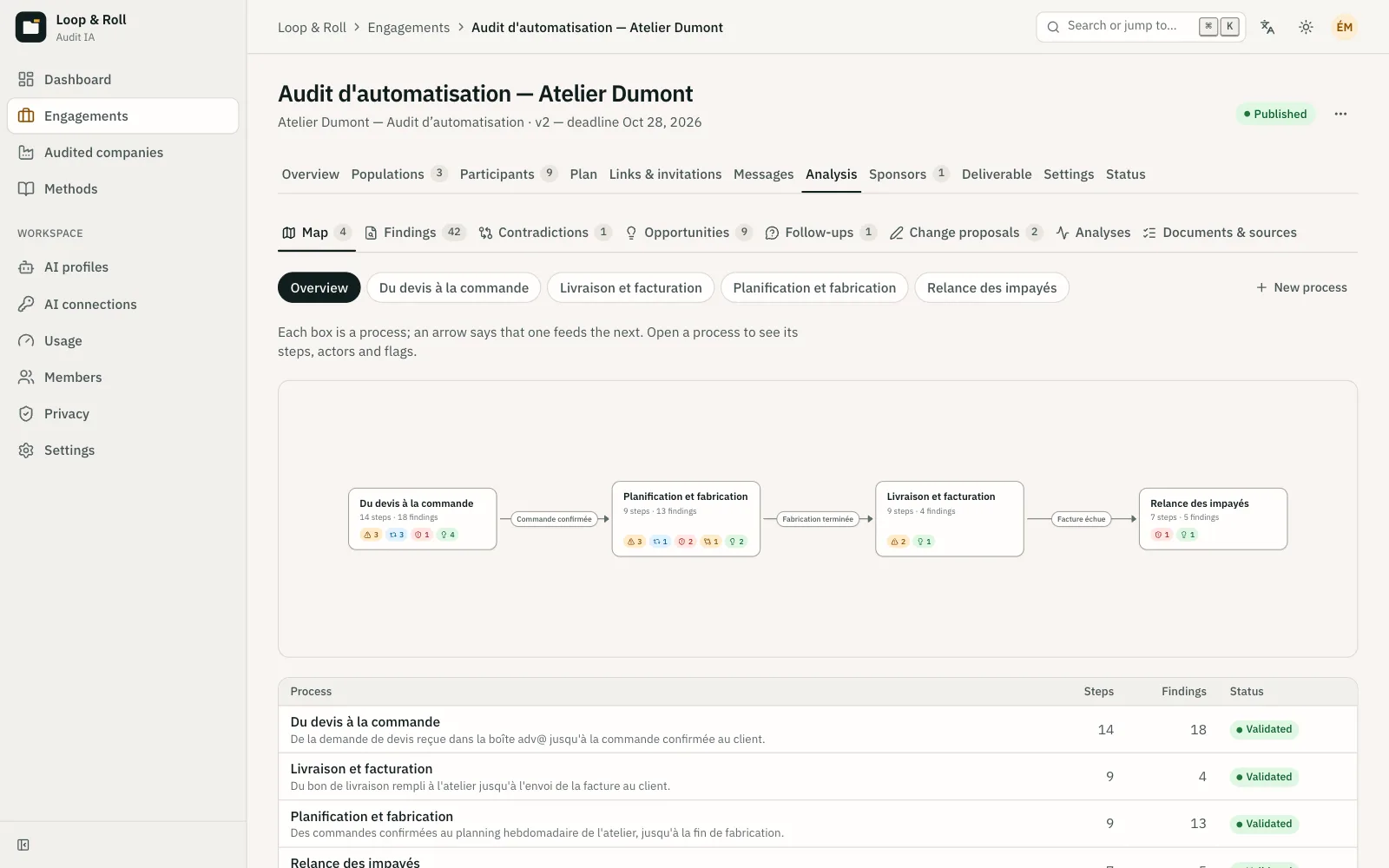
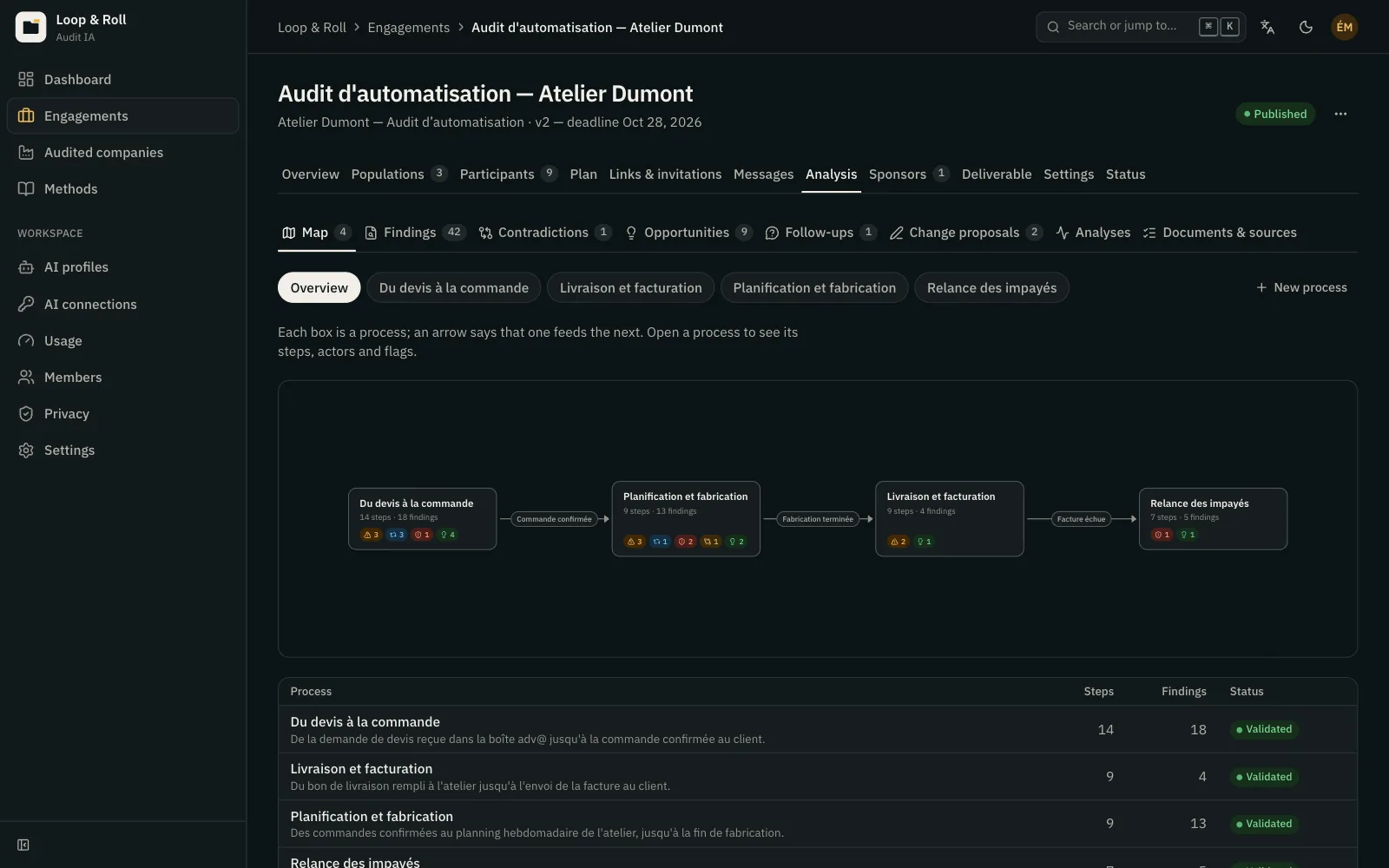
Interviews are the collection. What you sell is a process map that holds up, contradictions resolved, and volumes estimated, each one clickable down to the sentence or capture behind it.
Contradiction detected
Accounts payable
Invoices reach us already approved by the department head.
Logistics manager
I approve invoices when I have time, often after they have been entered.
Hypothesis: two practices coexist depending on the amount.
Proposed follow-up: 2 questions for the logistics manager, 5 minutes.
- Typed findings, each with a confidence level and at least one piece of evidence.
- Contradictions shown side by side, with a targeted follow-up to settle them.
- Volumes and durations as ranges, with the number of sources behind them.
Nothing without evidence
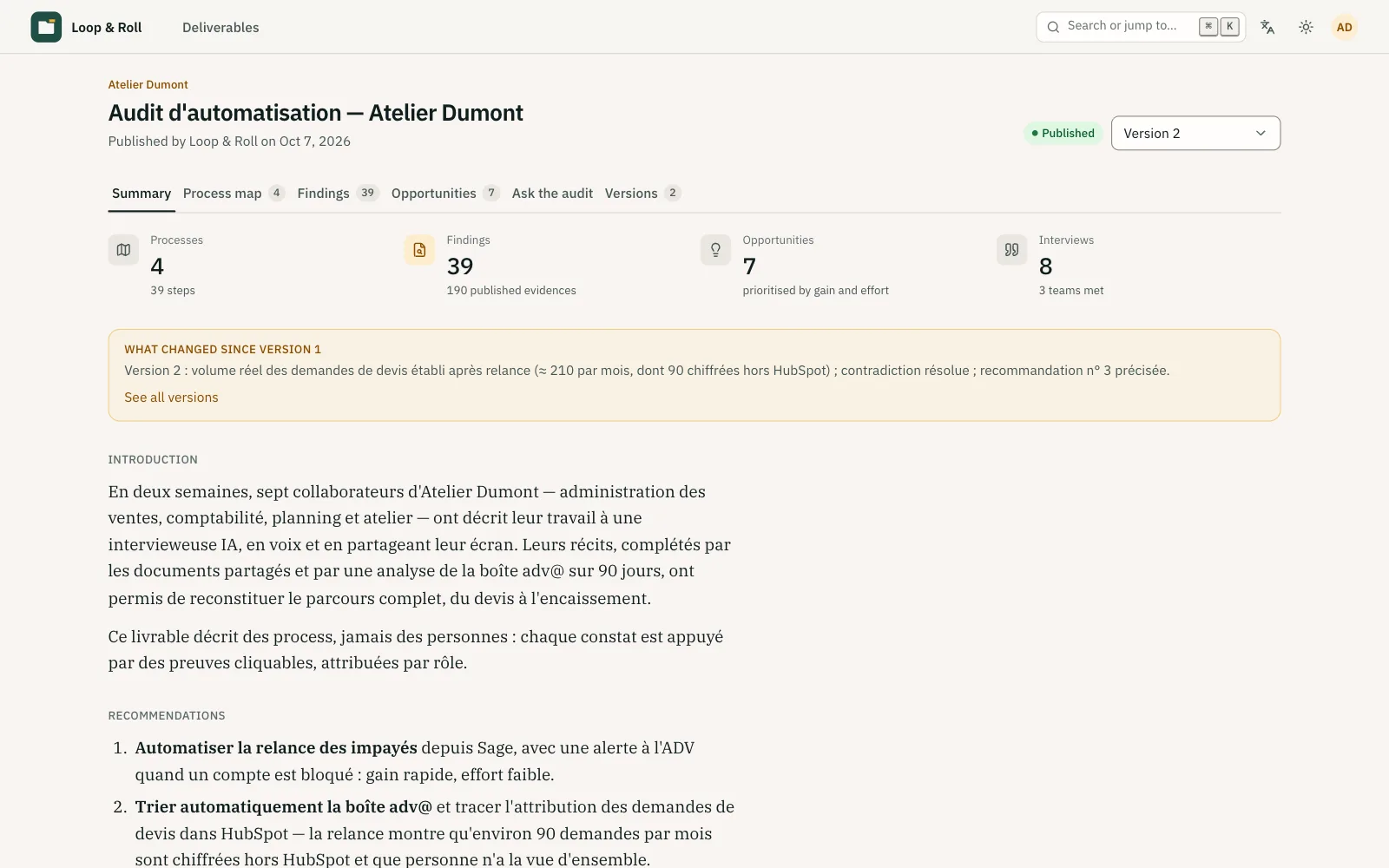
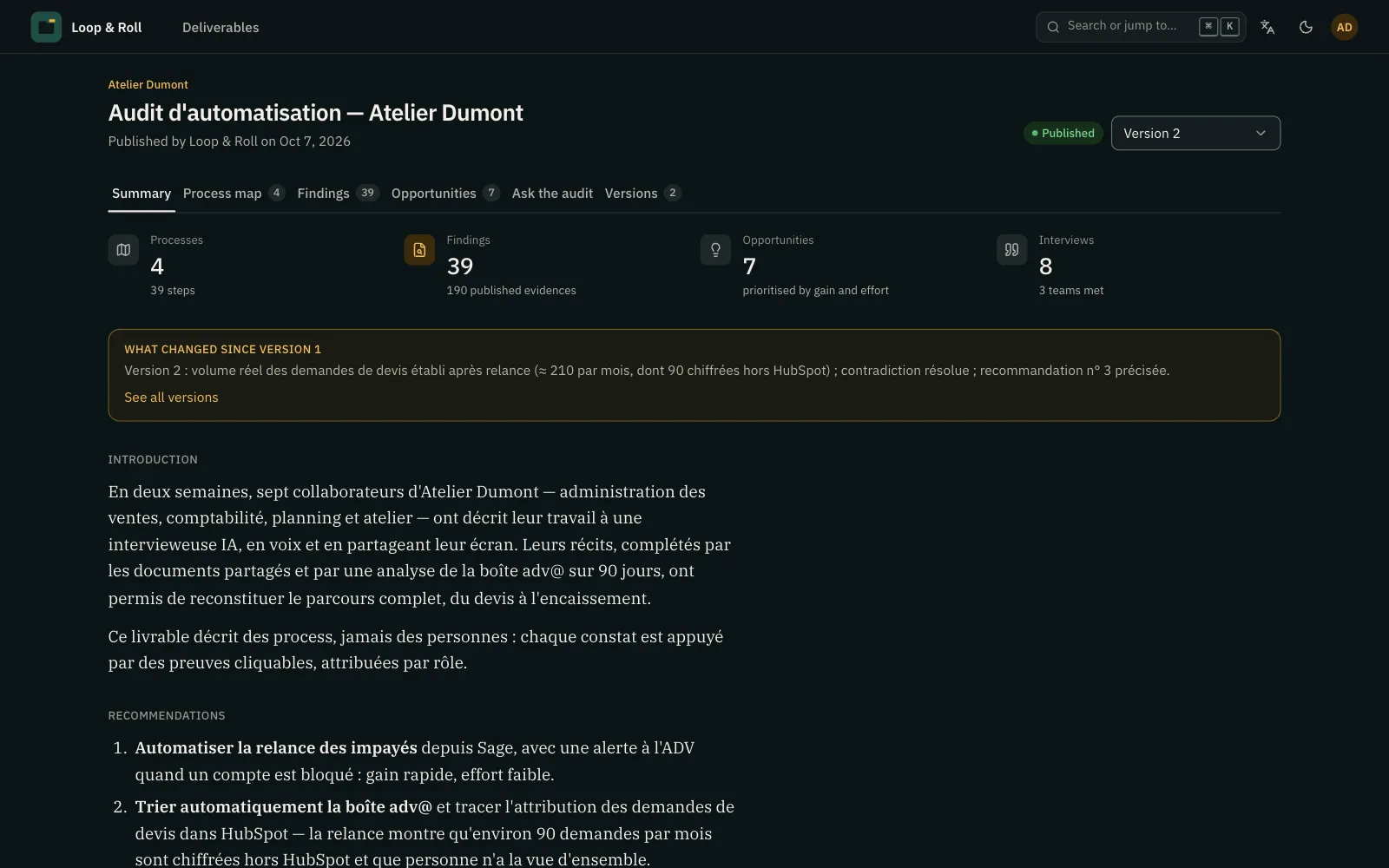
Every element of the deliverable, whether a step, a figure, a pain point, or an opportunity, links to at least one piece of evidence the sponsor can open.
About 40 orders a day, all re-keyed into the ERP.
Attributed by role, never by name. The sponsor only sees published excerpts, never the full recording.
-
Audio clip
The exact sentence, timestamped, with its transcript and a few seconds of context.
-
Pinned capture
The screen at the moment the employee shows it, in full resolution, redacted if needed.
-
Uploaded file
The export, procedure, or spreadsheet shared during the interview, down to the page.
-
External source
Data imported in the exchange format, confirming or contradicting what was said.
We assess processes, never people
This is a product rule, not a setting. It protects employees, and therefore the quality of what they tell you.
-
No individual scores
No ratings, rankings, or comparisons of people, anywhere: not on screen, not in exports, not in the chat.
-
No emotion analysis
We analyze what is said and shown, not how it is said. Emotion recognition at work is prohibited by the AI Act.
-
The employee stays in control
Pause, mute, stop sharing, delete a passage, remove a point: what is removed is really gone.
-
The sponsor never sees raw data
They read the synthesis and the evidence the consultant chose to publish, never a full recording.
-
Retention periods
Raw recordings are kept for 90 days by default, then purged; cascading deletion on request.
-
A kit for works councils
Information notice, DPIA template, data processing agreement: what you need to consult before launch.
For firms that run process audits
Your method, your brand, several clients at once, and a neutral output: a deliverable and exports, with no platform imposed on your clients.
- Organizational consulting An organizational diagnosis informed by every employee, with a process map that shows its sources.
- Digital transformation The baseline before the program: the tools people actually use, not just the ones on the IT roadmap.
- ERP / CRM integrators Requirements gathering grounded in how current systems are really used, with BPMN export.
- Automation agencies Spot repetitive tasks, estimate their volumes with sources, and back every proposal with facts.
- Quality and compliance The gap between written procedure and actual practice, documented with time-stamped evidence.
- IT and internal teams The same tool, for internal audits: real application usage, pain points, and shadow applications.
Frequently asked questions
What is TellMeHow?
TellMeHow is a process audit tool for consulting firms. An AI runs the interviews with the audited company’s employees, by voice and while seeing the screen they share, then consolidates every interview into a process map where each finding is linked to its evidence.
Does the employee need to install anything?
No. They receive a personal link and do their interview in the browser, without an account. On a computer they share their screen; on a phone or tablet the interview runs voice-only, with the option to upload screenshots.
Does the AI replace the consultant?
No. It takes on collection and consolidation. The consultant defines the method and topics, reviews and corrects the analysis, decides on follow-ups, and writes the recommendations before publishing the deliverable.
Do employees know they are talking to an AI?
Yes, from the invitation and on the welcome screen, as Article 50 of the AI Act requires. The welcome screen also states what is recorded, who will see what, how long it is kept, and what their rights are.
What does the sponsor see on the client side?
The published deliverable: synthesis, process map, findings, opportunities, and the evidence the consultant chose to publish, attributed by role. They never see a full recording or a complete transcript, and the progress they follow is aggregated by population.
Which languages does TellMeHow support?
French and English today, for the interface, interviews, emails, and the deliverable. Another language is added through translation files, with no development work.
See a complete audit in thirty minutes.
A voice interview with screen sharing, the process map it produces, the deliverable the sponsor reads: on a demo engagement, with your questions.